
Local Experience
A City Built in Rings, Not One Era
Raleigh home inspections look different depending on which ring of the city you’re in. Raleigh isn’t one housing market — it’s several, stacked outward from downtown. The in-town neighborhoods close to the Capitol and NC State predate most of the city’s modern code. North Raleigh’s early subdivisions went up through the 1960s, 70s, and 80s. Everything past the Beltline keeps pushing newer still. We inspect all three rings every week to the same standards of practice, and what we typically find can differ a lot depending on which one you’re buying into. The in-town neighborhoods close to the Capitol and NC State predate most of the city’s modern code. North Raleigh’s early subdivisions went up through the 1960s, 70s, and 80s. Everything past the Beltline keeps pushing newer still. We inspect all three rings every week to the same standards of practice, and what we typically find can differ a lot depending on which one you’re buying into.
As Licensed General Contractors as well as Home Inspectors, we don’t just flag a problem — we can walk you through the repair process behind it and what the work actually involves. If you’re getting ready to list, Dave’s guide on preparing your home for inspection is worth a read before we arrive.
What We Typically Find
Historic Raleigh vs. the North Raleigh Growth Years
Two very different eras, two very different findings profiles — especially once you’re outside the Beltline.
Pre-War & Post-War
Pre-War & Post-War Raleigh
Homes from the 1920s through the 1950s cluster in Raleigh’s older in-town neighborhoods, close to downtown and NC State. Many were built well before modern electrical and plumbing code existed, and have been added onto or updated in pieces ever since.
- Original or partially-updated wiring and plumbing
- Knob-and-tube wiring, cast iron drain lines, and other pre-code holdovers
- Roofs and HVAC systems well past a single owner’s install date
1960s–80s Growth
North Raleigh’s First Wave
North Raleigh’s earliest subdivisions went up through the 1960s, 70s, and 80s — well before the newer growth further out. It’s a different set of issues than either the historic core or today’s new construction.
- Original systems reaching the end of a long service life
- Items still covered under a builder’s one-year warranty on newer infill
- The geology-driven radon question this page covers below
Radon Is a Real Question for Raleigh Buyers
Radon testing comes up on almost every Raleigh home inspection we perform. Radon occurs at different levels depending on the underlying geology, and based on what Dave sees inspection to inspection, elevated readings turn up more often in Raleigh — particularly North Raleigh — than in some of our other Triangle service areas. That doesn’t mean it’s not worth testing everywhere; radon can occur in any home, in any neighborhood, regardless of age or price point. It means Raleigh buyers in particular shouldn’t skip this step.
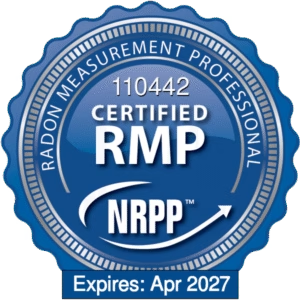
We offer AARST-NRPP certified radon measurement alongside your inspection, with results explained in plain language — not just a number on a lab report. It pairs naturally with the rest of your visit, so there’s no need to schedule anything separately.
Inspection Services
Raleigh Home Inspections:
Every Service Buyers & Sellers Need
From full pre-purchase evaluations to specialty diagnostics, each service below is performed personally by a licensed A-1 inspector — never subcontracted.
Home Inspections for Buyers
Full evaluation of structural, electrical, plumbing, and HVAC systems with photo-backed findings before you close.
Home Inspections for Sellers
Get ahead of surprises before you list — document the condition of your Raleigh home early and head into negotiations informed.
One-Year Warranty Inspections
Bought new somewhere past the Beltline? We review your build before the builder’s warranty runs out.
Radon Testing
AARST-NRPP certified radon measurement — see the dedicated section above on why it matters especially here in Raleigh.
Mold Inspection & Testing
Air and surface sampling by a MICRO Certified Mold Inspector, scheduled as its own service alongside your inspection.
Thermal Imaging
Infrared scans reveal hidden moisture and insulation gaps behind walls and ceilings — no demolition required.
Drone Inspections
FAA-licensed drone pilot capturing 4K roof and chimney footage — useful on both steep in-town rooflines and tall new builds.
Crawlspace Evaluation
Especially relevant in Raleigh’s older in-town neighborhoods, where crawlspace moisture and ventilation issues show up most often.
Commercial Building Inspections
Assessments for retail, office, and mixed-use properties across downtown and greater Raleigh.
Radon, mold sampling, thermal imaging, drone imagery, and air quality testing are ancillary services arranged under a separate agreement. North Carolina’s Standards of Practice for home inspectors exclude environmental concerns, so these are in addition to — not part of — a standard home inspection.
Not sure which you need? Call 919-886-7071.
Coverage Area
Neighborhoods We’ve
Actually Inspected In
From the historic core near downtown to North Raleigh and the newer growth beyond the Beltline, Raleigh covers a lot of ground.
In-Town & Established
Older systems, in-town lots, character homes.
Where
Five Points
Hayes Barton
Cameron Park
Mordecai
…and more!
Post-2000 Growth
1960s–80s growth, radon-aware buyers.
Where
North Hills
Lakemont
Millbrook
Wakefield
…and more!
Outlying & Rural Edge
Newer construction, outer-loop corridors.
Where
Brier Creek
Renaissance Park
North Ridge
…and more!
Don’t see your street?
What to Expect
Straightforward,
Thorough, No Surprises
Every Raleigh home inspection from A-1 follows the same standard, whether it’s a pre-war bungalow near downtown or new construction past the Beltline:
Decades of in-depth knowledge — built on more than 30,000 residential and commercial inspections, including homes throughout Raleigh.
Photo & video evidence included throughout, so you see exactly what we saw.
Findings walked through in person — on site, by Zoom, phone, or email, whichever you prefer.
Same-night reports — descriptive, easy-to-read, and delivered digitally the evening of your inspection.
Never subcontracted — your inspector will have personally performed a minimum of 10,000 inspections.
Open communication — easy to reach before your purchase and any time after, whether you’re closing on a historic in-town lot or new construction past the Beltline.
Testimonials
What Raleigh Area Clients Say
“Dave was extremely thorough with our home inspection. He answered all of our questions in great detail and provided context for our home buying process. Highly recommend Dave and A-1 House Inspectors!”
“I can’t imagine having had a better inspector than A-1. When my wife and I were about to buy a home A-1 was our choice. They were thorough, detailed, responsive and honest in everything they found. They saved us THOUSANDS of dollars by going above and beyond. I cannot recommend them enough.”
“We highly recommend A-1 House Inspectors! Dave and his team was efficient, responsive, and thorough.”
Licenses & Certifications
A-1 House Inspectors meets or exceeds the North Carolina Home Inspector Licensure Board Standards of Practice.

Common Questions
Raleigh Inspection FAQ
Answers to what buyers and sellers ask us most about Raleigh home inspections — schedule, older homes, radon, warranties, and mold.
Most inspections are scheduled within 1–3 business days, with same-night digital reports so you can stay inside your due-diligence window.
Older Raleigh homes often carry a mix of original and updated systems. We routinely check for knob-and-tube wiring, cast iron drain lines, and other pre-code holdovers in homes from this era, alongside the standard structural, electrical, plumbing, and HVAC review — all measured against the same standards of practice we apply everywhere.
Yes — it’s one of the more commonly overlooked inspections. Builders miss things, and a warranty inspection performed before the one-year mark lets us flag anything still covered under the builder’s warranty, which comes up regularly for buyers in Raleigh’s newer subdivisions past the Beltline.
Yes — we regularly inspect homes throughout Wake County, plus our other Triangle service areas in Cary, Apex, Holly Springs, and Fuquay-Varina.
We do, as a separate, ancillary service — North Carolina’s Standards of Practice for home inspectors specifically exclude environmental concerns, so mold sampling isn’t bundled into a standard inspection and is scheduled under its own agreement. Dave is a MICRO-certified Mold Inspector (CMI) and performs the air and surface sampling himself, with lab analysis on the results — relevant on Raleigh’s older in-town homes just as much as anywhere past the Beltline.
This kind of testing is a starting point rather than a solution: it confirms whether mold levels are elevated. If they are, the next call is an accredited environmental professional whose credentials go further than a home inspector’s. One thing worth knowing: North Carolina doesn’t license mold inspection at all, so ask any provider what their certification actually covers.
Still have a question? Send it to Dave.
From the Blog
Raleigh Inspection Insights
-
Home Inspection Client or Commodity?
There is a fast growing trend in the home inspection community to sell your data for kickbacks, or other compensation to a variety of 3rd…
-
Home Sellers: Preparing For A Home Inspection
Expert Advice for Home Sellers: How to Prepare Your Home for Inspection Selling a home can be an exciting yet stressful process, and one of…